THE SYRIAC APOCALYPSE OF BARUCH FROM THE PESHITTA BIBLE
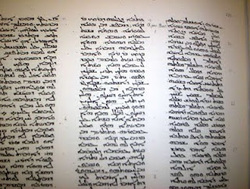
The manuscript is in Syriac script and was written in the sixth or seventh century C.E. It contains the Old Testament books, the Apocrypha, and other works such as 4 Ezra, 2 Baruch, 3-4 Maccabees and a section from Josephus on the Maccabees. 2 Baruch begins at the top of the middle column. It opens:
"The Book of the Revelation of Baruch son of Neriah, which is taken from Greek into Syriac."
THE GOSPEL OF THOMAS
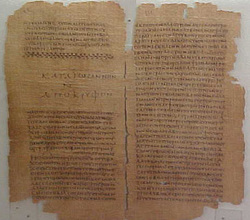
Nag Hammadi Codex II, folio 32, the beginning of the Gospel of Thomas. The text has also been identified in fragments of the Oxyrhynchus Papyri (1, 654 and 655). Both the Coptic Nag Hammadi and Greek Papyri have been found to be dependent upon a Syriac translation.
THE BOOK OF ENOCH
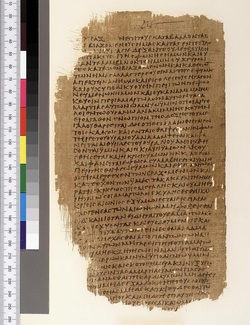
Chester Beatty XII, Greek manuscript of the Book of Enoch, 4th century including 97:6–107:3. The book has also been found in fragments among the Dead Sea Scrolls. Numerous fragments in Aramaic containing I Enoch covering chapters 1 up to 107 were identified. Also, a Hebrew fragment containing 8:4–9:4, 106 was also discovered. The book is also alluded to in the Epistle of Jude in the New Testament with a direct quote.
THE LATIN VULGATE
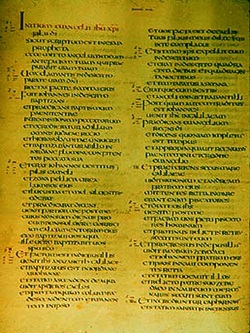
VULGATE MANUSCRIPT
Codex Amiatinus - AD 750. The Apocryphal books of I-II Esdras were seen later in the Clementine Vulgate of AD 1592. The Prayer of Manasseh had already been included in a 4th century Vulgate Version appended to II Chronicles. Out of these three, only I Esdras and The Prayer of Manasseh originally were included in the Septuagint. Tracing the origin of II Esdras is very difficult but there may have been a version of the Septuagint that did include it. II Esdras 16:57-59 has indeed been discovered in Greek in the Oxyrhynchus Papyri 1010 which gives credibility to the theory of a lost Septuagint containing this book.
Codex Amiatinus - AD 750. The Apocryphal books of I-II Esdras were seen later in the Clementine Vulgate of AD 1592. The Prayer of Manasseh had already been included in a 4th century Vulgate Version appended to II Chronicles. Out of these three, only I Esdras and The Prayer of Manasseh originally were included in the Septuagint. Tracing the origin of II Esdras is very difficult but there may have been a version of the Septuagint that did include it. II Esdras 16:57-59 has indeed been discovered in Greek in the Oxyrhynchus Papyri 1010 which gives credibility to the theory of a lost Septuagint containing this book.
GREEK OLD AND NEW TESTAMENTS
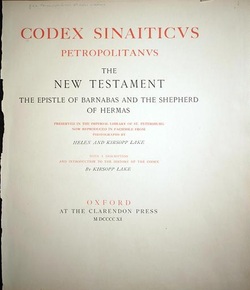
Title page to a reprint of the Codex Sinaiticus. This manuscript contains about half of the Old Testament and all of the New Testament, including the Epistle of Barnabas and The Shepherd of Hermas
CODEX FULDENSIS LATIN VULGATE
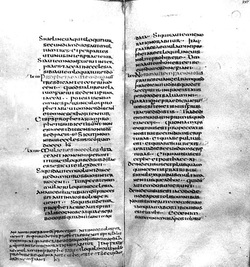
Page from the Latin Vulgate Codex Fuldensis. It contains the Diatessaron and 23 canonical books of the New Testament; plus the Epistle to the Laodiceans, and a copy of Jerome's Prologue to the Canonical Gospels. It is an important witness in any discussion about the authenticity of 1 Corinthians 14:34-35
THE "GOSPEL" OF MARY
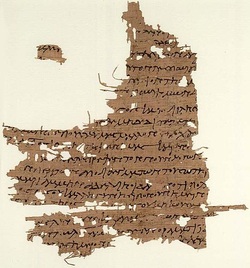
The Papyrus Berolinensis 8502 of the "gospel" discovered in 1896. Two other fragments of the Gospel of Mary have been discovered since, both written in Greek (Papyrus Oxyrhynchus L 3525 and Papyrus Rylands 463)
III CORINTHIANS
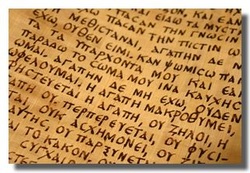
It is also found in the Acts of Paul, and was framed as Paul's response to the Epistle of the Corinthians to Paul. The earliest extant copy is Bodmer Papyrus X. Although part of the Oskan Armenian Bible of 1666, it was in an Appendix to the Zohrab Armenian Bible of 1805 which follows the Vulgate canon, and it is not currently considered part of the Armenian Orthodox New Testament
THE BOOK OF JASHER
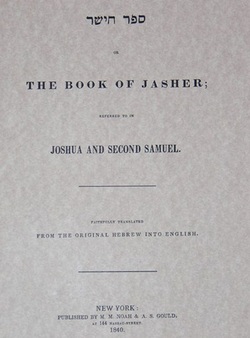
This is one of the apochrypal Books of Jasher. There are several (as many as five) separate works by this title, all composed much later than Biblical times. This particular one is a translation of a Hebrew book printed in 1613. Sepir Ha Yasher, the Hebrew title of this book, means the 'Book of the Upright', or 'the Upright or Correct Record'. This title was misread as 'Jasher', and at some point Jasher was treated as a proper name; however the pronoun 'the' (hebrew 'ha') never preceeds proper names. There is also another spurious Book of Jasher, published 1750, in which Jasher is treated as the name of the author. This text covers much of the same ground as the traditional Mosaic books of the Bible, from the creation of the world to the death of Moses, albeit with several minor variations.
II ESDRAS
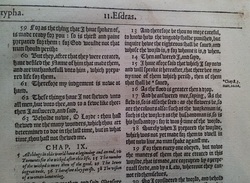
The text of the Codex Sangermanensis I, written on vellum, is a version of the Latin. The manuscript contains the Vulgate Bible, on 191 leaves (39.3 by 33 cm) of which, in the New Testament, the Gospel of Matthew contain Old Latin readings. It contains The Shepherd of Hermas also. In Second Esdras, chapter 7, verse 35, the majority of surviving Latin manuscripts read:
". . . et justitiae vigilabunt, et injustitiae non dormibunt. primus Abraham propter Sodomitas et Moyses . . ."
or
". . . good deeds shall be of force, and wicked deeds shall bear no rule. Then said I, Abraham prayed first for the Sodomites, and Moses for . . ."
So called missing verses have been added to modern versions that teach an apocalyptic vision of hell. "Scholars" believe these verses were part of the original book but by careful study, it is an obvious interpolation. The King James Version and Clementine Vulgate of II Esdras represent the truest form of the book. The ancient reader of the Codex Sangermanensis knew the verses were fraudulent and excised them as a witness of their inauthenticity. These "new" verses are a discredit to the inspiration of II Esdras and a superstitious addition that does not belong in the intelligent thought pattern of II Esdras.
". . . et justitiae vigilabunt, et injustitiae non dormibunt. primus Abraham propter Sodomitas et Moyses . . ."
or
". . . good deeds shall be of force, and wicked deeds shall bear no rule. Then said I, Abraham prayed first for the Sodomites, and Moses for . . ."
So called missing verses have been added to modern versions that teach an apocalyptic vision of hell. "Scholars" believe these verses were part of the original book but by careful study, it is an obvious interpolation. The King James Version and Clementine Vulgate of II Esdras represent the truest form of the book. The ancient reader of the Codex Sangermanensis knew the verses were fraudulent and excised them as a witness of their inauthenticity. These "new" verses are a discredit to the inspiration of II Esdras and a superstitious addition that does not belong in the intelligent thought pattern of II Esdras.
MISSATICUM BIBLIA (or, Book of the Two Pearls)
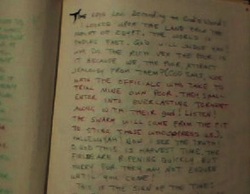
Photo of a page from the English translation of Missaticum Biblia (the Prophecy of Timotheus [Hadar] and Levi [Melech] section). Discovered in 1995 by an unknown individual. The photos and transcripts are all that SeRMoN has in its possession. The document cannot be authenticated. Just recently, it was discovered that a work entitled "The Book of Joseph" formed part of the Missaticum Biblia because of the various similarities of both texts. SeRMoN has combined both into one English translation and a new Greek transliteration. The Latin text does not contain The Book of Joseph. It is also the opinion of SeRMoN that the Joseph Manuscript is not a Mormon work as once believed.
SECRET GOSPEL OF MARK
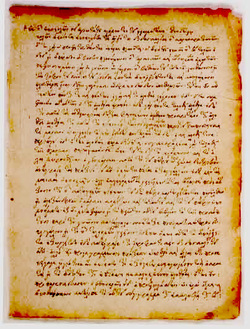
A putative non-canonical Christian gospel known exclusively from the Mar Saba letter, which describes Secret Mark as an expanded version of the canonical Gospel of Mark with some episodes elucidated, written for an initiated elite. In 1973, Morton Smith claimed to have found a previously unknown letter of Clement of Alexandria in the monastery of Mar Saba on the West Bank transcribed into the end papers of a 17th-century printed edition of the works of Ignatius of Antioch. The original manuscript was subsequently transferred to another monastery, and the manuscript is believed to be lost. Further research has relied upon photographs and copies, including those made by Smith himself. The revelation of the letter caused a sensation at the time, but was soon met with accusations of forgery and misrepresentation. Subsequent study, including handwriting analysis of higher quality color photographs of the document, first published in 2000, revealed more possible evidence of forgery, leading scholars such as Craig A. Evans and Emanuel Tov to conclude the work is a hoax, with Smith being the most likely perpetrator. However, while an increasing number of scholars have been convinced of this view, many still maintain that the Mar Saba letter itself is genuine, and debate continues about the authenticity of the letter and the Secret Gospel it describes.
SHAPIRA STRIPS
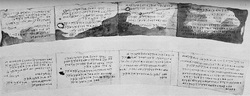
In 1883 Moses Shapira presented what is now known as the Shapira Strips, fragments of supposedly ancient parchment he claimed to have found near the Dead Sea. Their inscriptions of ancient Semitic script hinted at a different version of the Ten Commandments and Deuteronomy. Archeologists now believe the scrolls may have been the real artifact, and not a forgery as previously assumed. The search for the scrolls by author Chanan Tigay is ongoing. It is uncertain if the Scrolls were destroyed in a fire, as previously suggested.
BOOK OF ABRAHAM
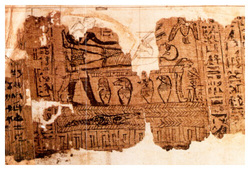
An 1835 work produced by Joseph Smith that he said was based on Egyptian papyri purchased from a traveling mummy exhibition. According to Smith, the book was:
"a translation of some ancient records ... purporting to be the writings of Abraham, while he was in Egypt, called the Book of Abraham, written by his own hand, upon papyrus".
Smith's translation of the papyri describes a story of Abraham's early life, including a vision of the cosmos. The Book of Abraham papyri were thought lost in the 1871 Great Chicago Fire. However, in 1966 several fragments of the papyri were found in the archives of the Metropolitan Museum of Art in New York, and in the LDS Church archives. They are now referred to as the Joseph Smith Papyri. Upon examination by professional Mormon and non-Mormon Egyptologists, the papyri were found to bear no resemblance to Joseph Smith's interpretation, and were common Egyptian funerary texts, dating to about the first century BC. As a result, the Book of Abraham has been the source of significant controversy, with Mormon apologists offering a variety of explanations as to the reason for the differences.
"a translation of some ancient records ... purporting to be the writings of Abraham, while he was in Egypt, called the Book of Abraham, written by his own hand, upon papyrus".
Smith's translation of the papyri describes a story of Abraham's early life, including a vision of the cosmos. The Book of Abraham papyri were thought lost in the 1871 Great Chicago Fire. However, in 1966 several fragments of the papyri were found in the archives of the Metropolitan Museum of Art in New York, and in the LDS Church archives. They are now referred to as the Joseph Smith Papyri. Upon examination by professional Mormon and non-Mormon Egyptologists, the papyri were found to bear no resemblance to Joseph Smith's interpretation, and were common Egyptian funerary texts, dating to about the first century BC. As a result, the Book of Abraham has been the source of significant controversy, with Mormon apologists offering a variety of explanations as to the reason for the differences.
BOOK OF RAZIEL
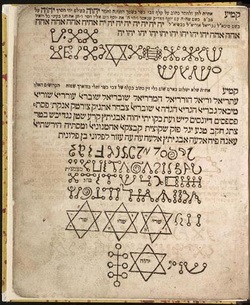
A medieval Kabbalistic grimoire, primarily written in Hebrew and Aramaic, but surviving also in Latin translation, as Liber Razielis Archangeli, in a 13th century manuscript produced under Alfonso X. The tradition around the book attributes it to have been revealed to Adam by the angel Raziel. The title itself is mentioned in another magical work of late antiquity, The Sword of Moses. The printed version of Sefer Raziel is divided into five books, some of it in the form of a mystical Midrash on Creation. It features an elaborate angelology, magical uses of the zodiac, gematria, names of God, protective spells, and a method of writing magical healing amulets. The Book of Raziel explains everything from Astrology of the planets in our solar system, and explains how the creative life energy starts with a thought from the spiritual realms, transcending into speech and action in this physical world. The eternal divine creative life energy of this earth is love, the book explains the spiritual laws of birth, death, reincarnation of the soul, and many spiritual laws of "Change".
NEW TESTAMENT APOCRYPHA
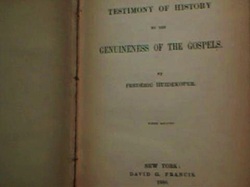
A copy of a book in the possession of SeRMoN entitled: "Indirect Testimony of History To the Genuineness of the Gospels" by Frederic Huidekoper (1886). This book contains the New Testament Apocryphal texts of THE ACTS OF PILATE, THE REPORT OF PILATE, LETTER OF JESUS AND ABGARUS, LETTER OF LENTULUS, PSEUDO-THADDEUS, PAUL AND SENECA and SIBYLLINE ORACLES (selections). This is a great comparison text and it has been used to compare the texts that are featured on this site. The copy we have is the 5th edition.
WILLIAM TYNDALE NEW TESTAMENT
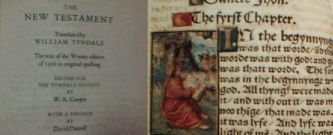
This book was purchased by me some time ago at a lecture on the Dead Sea Scrolls and other ancient MSS. The artifacts on display ranged from a very large Hebrew Scroll to ancient versions of the Bible. There were various fragments of Dead Sea Scrolls on display as well. I talked to a number of scholars. This version of the Bible is unique because Revelation 13:2 is rendered:
"And the best which I sawe, was lyke a catt off the mountayne..."
Other versions say "like a leopard.." Tyndale’s translations were condemned in England, where his work was banned and copies burned. Catholic officials charged that he had purposely mistranslated the ancient texts in order to promote anti-clericalism and heretical views. Betrayed to church officials in 1536, he was defrocked in an elaborate public ceremony and turned over to the civil authorities to be strangled to death and burned at the stake. His last words are said to have been, "Lord, open the eyes of the king of England!"
"And the best which I sawe, was lyke a catt off the mountayne..."
Other versions say "like a leopard.." Tyndale’s translations were condemned in England, where his work was banned and copies burned. Catholic officials charged that he had purposely mistranslated the ancient texts in order to promote anti-clericalism and heretical views. Betrayed to church officials in 1536, he was defrocked in an elaborate public ceremony and turned over to the civil authorities to be strangled to death and burned at the stake. His last words are said to have been, "Lord, open the eyes of the king of England!"
BOOK OF JOSEPH MS REVEALED!
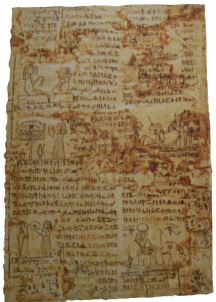
The source of this document states:
When the great Prophet and Historian Moses wrote the original version of Genesis it included a copy of . . . a book of stories about Joseph's life he wrote called The Book of Joseph.
The writing on the manuscript appears to be a Semitic language of some sort. The MS cannot be of Mormon origin for the simple fact that it bears no similarity to anything "Mormon". Close-ups show Egyptian drawings that appear to tell a narrative along with the text. It is a sort of picture book, one might say.
ARMENIAN ADAM BOOK
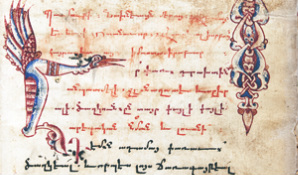
Composed in the fourteenth century, the Book of Adam is a poem by Aṛak ‘el Siwnets‘i (Arakel of Siwnik), scholar and abbot of the renowned monastery of Tat‘ew. The poem contrasts Old Testament Adam with the new Adam, Jesus Christ. The Library’s manuscript was copied in the churches of Surb Astuatsatsin (the Holy Mother of God) and Surb Kaṛasunk ‘ (the Holy Forty) in Aleppo in 1102 of the Armenian era (AD 1653). This is the opening page of the Book of Adam, with its relatively simple headpiece (the ornamental design at the beginning of the text). Part of the text says:
"The glory of Paradise was the indescribable, of marvelous appearance and enchanting. The flowers gave brightness to brightness like the sun and the moon. Adam's countenance flowered with glory and was like light, radiating, flashes of light streamed from him and scintillated like fire . . . "
The book has been published in English by Michael E. Stone, a leading scholar of Armenian studies.
"The glory of Paradise was the indescribable, of marvelous appearance and enchanting. The flowers gave brightness to brightness like the sun and the moon. Adam's countenance flowered with glory and was like light, radiating, flashes of light streamed from him and scintillated like fire . . . "
The book has been published in English by Michael E. Stone, a leading scholar of Armenian studies.
THE CATHAR RITUAL or LYON RITUAL
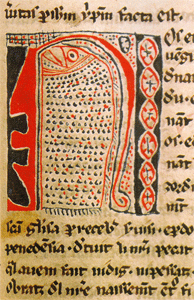
This Occitan Cathar ritual is appended to the New Testament in ms. Palais des Arts 36, Bibliothèque municipale de Lyon (ff. 325v-241v). The dialect of both texts is Languedocian though the language of the ritual diverges somewhat from that of the N.T., especially as regards a sprinkling of Italianisms, most notably in the Servissi. The manuscript was probably copied in northern Italy around the middle of the first half of 14th century. What did the Cathars believe? The Cathars certainly had some ideas that were grossly heretical by the standards of any orthodox modern church. They firmly rejected the Old Testament, and the Incarnation. Their elite believers, the perfecti, followed the ancient Encratites in rejecting any sexual contact, and the eating of any food apart from vegetables and fish. Believers entered the state of perfection by accepting spiritual baptism, the consolamentum, which involved a laying on of hands in the presence of the Gospel of John. For Protestants, Catholics and Orthodox alike, this was a profoundly strange form of the Christian faith. At the same time, though, Cathars defined themselves as firmly part of the Christian tradition, and its recorded rituals draw entirely on the New Testament, as they understood it. So close in fact is the Cathar ritual to the ancient Baptism of the Catechumens that modern scholars have suggested a direct inheritance, possibly by means of ancient texts that were still available to these alternative believers.
ALPHABET OF BEN SIRA
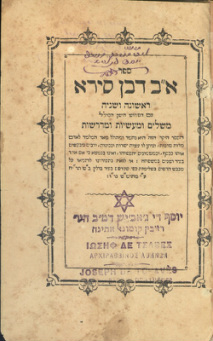
The Alphabet of Ben Sira is one of the earliest, most complicated, and most sophisticated Hebrew stories written in the Middle Ages. The complete work contains four parts. The first part is the biography of Ben Sira from his conception until the age of one year. This story, omitted in many editions, explains how Jeremiah, the prophet, was simultaneously Ben Sira's father. The second part is more sophisticated in form. It tells how Ben Sira, now one year old, meets with his teacher, who tries to teach him the alphabet. Instead of repeating each letter of the alphabet after his teacher, Ben Sira responds with an epigram beginning with that letter. The third part is the longest and contains most of the narrative material in this work. It recounts the story of Ben Sira's life and adventures in the court of Nebuchadnezzar, king of Babylonia. It also includes stories told by Ben Sira himself as answers to the king's questions. These stories often include pornographic elements, as well as derogatory descriptions of biblical figures, like King Solomon or Joshua. Some of the stories in this section contain motifs from international folklore and may be based on folktales. The fourth part, which is found in most versions and gave the work its name, contains 22 alphabetically arranged epigrams attributed to Ben Sira that serve as material for discussion and interpretation by Ben Sira's son, Uzziel, and his grandson, Joseph b. Uzziel. The contents are satirical and even heretical.
EXCERPTS:
THE FIRST 22 PROVERBS:
1. Honor the physician before thou hast need of him.
2. The son who is not clear-witted, leave him upon the surface of the water and let him swim.
3. The bone that has fallen to thy lot, whether it be good or evil, gnaw it.
4. Gold must be hammered, and a child must be beaten.
5. Be good, and thy portion of goodness do not refuse.
6. Woe to the wicked, and woe to them that consort with him.
7. Cast thy bread upon the waters, for thou shalt find it at the end of the days.
8. Hast thou seen white and black combined? It is neither black nor white.
9. Do not good to the evil, and evil shall not befall thee.
10. Restrain not thy hand from doing good.
11. The bride goes into the canopy, and knows not what is coming upon her.
12. For a wise man with a sign, for a fool with the fist.
13. He who honors a man that despises him, is like an ass.
14. A fire when it is kindled burns many sheaves.
15. An old man in a house is a good sign in the house.
16. A good surety is for a hundred days, but an evil surety is for a thousand thousand.
17. Make clear the explanation, and remove differences.
18. If thou must trade, let thy lot be with the lucky.
19. Stock that is near at hand its owner consumes, but that which is far off consumes its owner.
20. An old friend do not thou repudiate.
21. Take sixty counselors, but the counsel of thy heart do not abandon.
22. Let the hand be given to thee when it is satisfied, but not when it is hungry.
CONCERNING LILITH:
Soon afterward the young son of the king took ill. Said Nebuchadnezzar, "Heal my son. If you don't, I will kill you." Ben Sira immediately sat down and wrote an amulet with the Holy Name, and he inscribed on it the angels in charge of medicine by their names, forms, and images, and by their wings, hands, and feet. Nebuchadnezzar looked at the amulet. "Who are these?"
"The angels who are in charge of medicine: Senoy, Sansenoy and Semangelof. While God created Adam, who was alone, He said, 'It is not good for man to be alone'. He also created a woman, from the earth, as He had created Adam himself, and called her Lilith. Adam and Lilith immediately began to fight. She said, 'I will not lie below,' and he said, 'I will not lie beneath you, but only on top. For you are fit only to be in the bottom position, while I am to be the superior one.' Lilith responded, 'We are equal to each other inasmuch as we were both created from the earth.' But they would not listen to one another. When Lilith saw this, she pronounced the Ineffable Name and flew away into the air. Adam stood in prayer before his Creator: 'Sovereign of the universe!' he said, 'the woman you gave me has run away.' At once, the Holy One, blessed be He, sent these three angels to bring her back.
"Said the Holy One to Adam, 'If she agrees to come back, what is made is good. If not, she must permit one hundred of her children to die every day.' The angels left God and pursued Lilith, whom they overtook in the midst of the sea, in the mighty waters wherein the Egyptians were destined to drown. They told her God's word, but she did not wish to return. The angels said, 'We shall drown you in the sea.'
"'Leave me!' she said. 'I was created only to cause sickness to infants. If the infant is male, I have dominion over him for eight days after his birth, and if female, for twenty days.'
"When the angels heard Lilith's words, they insisted she go back. But she swore to them by the name of the living and eternal God: 'Whenever I see you or your names or your forms in an amulet, I will have no power over that infant.' She also agreed to have one hundred of her children die every day. Accordingly, every day one hundred demons perish, and for the same reason, we write the angels names on the amulets of young children. When Lilith sees their names, she remembers her oath, and the child recovers."
EXCERPTS:
THE FIRST 22 PROVERBS:
1. Honor the physician before thou hast need of him.
2. The son who is not clear-witted, leave him upon the surface of the water and let him swim.
3. The bone that has fallen to thy lot, whether it be good or evil, gnaw it.
4. Gold must be hammered, and a child must be beaten.
5. Be good, and thy portion of goodness do not refuse.
6. Woe to the wicked, and woe to them that consort with him.
7. Cast thy bread upon the waters, for thou shalt find it at the end of the days.
8. Hast thou seen white and black combined? It is neither black nor white.
9. Do not good to the evil, and evil shall not befall thee.
10. Restrain not thy hand from doing good.
11. The bride goes into the canopy, and knows not what is coming upon her.
12. For a wise man with a sign, for a fool with the fist.
13. He who honors a man that despises him, is like an ass.
14. A fire when it is kindled burns many sheaves.
15. An old man in a house is a good sign in the house.
16. A good surety is for a hundred days, but an evil surety is for a thousand thousand.
17. Make clear the explanation, and remove differences.
18. If thou must trade, let thy lot be with the lucky.
19. Stock that is near at hand its owner consumes, but that which is far off consumes its owner.
20. An old friend do not thou repudiate.
21. Take sixty counselors, but the counsel of thy heart do not abandon.
22. Let the hand be given to thee when it is satisfied, but not when it is hungry.
CONCERNING LILITH:
Soon afterward the young son of the king took ill. Said Nebuchadnezzar, "Heal my son. If you don't, I will kill you." Ben Sira immediately sat down and wrote an amulet with the Holy Name, and he inscribed on it the angels in charge of medicine by their names, forms, and images, and by their wings, hands, and feet. Nebuchadnezzar looked at the amulet. "Who are these?"
"The angels who are in charge of medicine: Senoy, Sansenoy and Semangelof. While God created Adam, who was alone, He said, 'It is not good for man to be alone'. He also created a woman, from the earth, as He had created Adam himself, and called her Lilith. Adam and Lilith immediately began to fight. She said, 'I will not lie below,' and he said, 'I will not lie beneath you, but only on top. For you are fit only to be in the bottom position, while I am to be the superior one.' Lilith responded, 'We are equal to each other inasmuch as we were both created from the earth.' But they would not listen to one another. When Lilith saw this, she pronounced the Ineffable Name and flew away into the air. Adam stood in prayer before his Creator: 'Sovereign of the universe!' he said, 'the woman you gave me has run away.' At once, the Holy One, blessed be He, sent these three angels to bring her back.
"Said the Holy One to Adam, 'If she agrees to come back, what is made is good. If not, she must permit one hundred of her children to die every day.' The angels left God and pursued Lilith, whom they overtook in the midst of the sea, in the mighty waters wherein the Egyptians were destined to drown. They told her God's word, but she did not wish to return. The angels said, 'We shall drown you in the sea.'
"'Leave me!' she said. 'I was created only to cause sickness to infants. If the infant is male, I have dominion over him for eight days after his birth, and if female, for twenty days.'
"When the angels heard Lilith's words, they insisted she go back. But she swore to them by the name of the living and eternal God: 'Whenever I see you or your names or your forms in an amulet, I will have no power over that infant.' She also agreed to have one hundred of her children die every day. Accordingly, every day one hundred demons perish, and for the same reason, we write the angels names on the amulets of young children. When Lilith sees their names, she remembers her oath, and the child recovers."
CODEX GIGAS
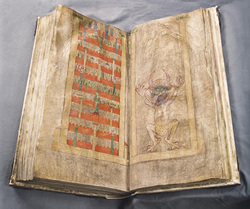
The Codex Gigas, or Giant Book, is the largest extant medieval manuscript in the world. It is also known as the Devil's Bible because of a large illustration of the devil on the inside and the legend surrounding its creation. It is thought to have been created in the early 13th century in the Benedictine monastery of Podlažice in Bohemia (modern Czech Republic). About half of the Codex consists of the entire Latin Bible in the Vulgate version, except for the books of Acts and Revelation, which are from a pre-Vulgate version. They are in the order Genesis-Ruth; Isaiah-Daniel; Hosea-Malachi; Job; Samuel and Kings; Psalms-Song of Solomon; Wisdom of Solomon; Wisdom of Jesus; Esdras; Tobit; Judith; Esther; and Maccabees. Between the Testaments are Josephus' Antiquities of the Jews and De bello iudaico (The Jewish War), as well as Isidore of Seville's encyclopedia Etymologiae and medical works of Hippocrates, Theophilus, Philaretus, and Constantinus. Following a blank page, the New Testament commences with Matthew-Acts, James-Revelation, and Romans-Hebrews.
Following the picture of the devil, Cosmas of Prague's Chronicle of Bohemia, a list of brothers in the Podlažice monastery, and a calendar with necrologium, magic formulae and other local records round out the codex. The entire document is written in Latin, in addition, it contains Hebrew, Greek, and Slavic alphabets (Cyrillic and Glagolitic). During the Thirty Years' War in 1648, the entire collection was taken by the Swedish army as plunder, and now it is preserved at the National Library of Sweden in Stockholm, though it is not normally on display.
The codex is bound in a wooden folder covered with leather and ornate metal. At 92 cm (36.2in.) tall, 50 cm (19.7in.) wide and 22 cm (8.6in.) thick it is the largest known medieval manuscript. Weighing 74.8 kg (165 pounds), Codex Gigas is composed of 310 leaves of parchment allegedly made from the skins of 160 donkeys or perhaps calfskin. The Codex Gigas is the world's largest medieval manuscript. It initially contained 320 sheets, though some of these were subsequently removed. It is unknown who removed the pages or for what purpose but it seems likely that they contained the monastic rules of the Benedictines.
According to one version of a legend that is already recorded in the Middle Ages the scribe was a monk who broke his monastic vows and was sentenced to be walled up alive. In order to forbear this harsh penalty he promised to create in one single night a book to glorify the monastery forever, including all human knowledge. Near midnight he became sure that he could not complete this task alone, so he made a special prayer, not addressed to God but to the fallen angel Lucifer, asking him to help him finish the book in exchange for his soul. The devil completed the manuscript and the monk added the devil's picture out of gratitude for his aid. In tests to recreate the work, it is estimated that reproducing only the calligraphy, without the illustrations or embellishments, would have taken 5 years of non-stop writing.
Following the picture of the devil, Cosmas of Prague's Chronicle of Bohemia, a list of brothers in the Podlažice monastery, and a calendar with necrologium, magic formulae and other local records round out the codex. The entire document is written in Latin, in addition, it contains Hebrew, Greek, and Slavic alphabets (Cyrillic and Glagolitic). During the Thirty Years' War in 1648, the entire collection was taken by the Swedish army as plunder, and now it is preserved at the National Library of Sweden in Stockholm, though it is not normally on display.
The codex is bound in a wooden folder covered with leather and ornate metal. At 92 cm (36.2in.) tall, 50 cm (19.7in.) wide and 22 cm (8.6in.) thick it is the largest known medieval manuscript. Weighing 74.8 kg (165 pounds), Codex Gigas is composed of 310 leaves of parchment allegedly made from the skins of 160 donkeys or perhaps calfskin. The Codex Gigas is the world's largest medieval manuscript. It initially contained 320 sheets, though some of these were subsequently removed. It is unknown who removed the pages or for what purpose but it seems likely that they contained the monastic rules of the Benedictines.
According to one version of a legend that is already recorded in the Middle Ages the scribe was a monk who broke his monastic vows and was sentenced to be walled up alive. In order to forbear this harsh penalty he promised to create in one single night a book to glorify the monastery forever, including all human knowledge. Near midnight he became sure that he could not complete this task alone, so he made a special prayer, not addressed to God but to the fallen angel Lucifer, asking him to help him finish the book in exchange for his soul. The devil completed the manuscript and the monk added the devil's picture out of gratitude for his aid. In tests to recreate the work, it is estimated that reproducing only the calligraphy, without the illustrations or embellishments, would have taken 5 years of non-stop writing.
